China Conducts Largest Military Exercises Near Taiwan Since 2022

China has resumed large-scale military flights around Taiwan after a 10-day break, increasing regional tensions. The U.S. has expressed concern as these actions are seen as part of a larger strategy of intimidation and preparation for a potential invasion.
Tensions Soar as China Resumes Large-Scale Military Flights Around Taiwan
Taipei, Taiwan – March 17, 2026 – Cross-strait tensions have surged to their highest point in months after China resumed large-scale military air incursions around Taiwan on March 14, following a brief and unexplained 10-day hiatus. The renewed show of force, involving dozens of advanced aircraft, has shattered the temporary calm and signals a continuation of Beijing’s campaign of military pressure against the self-governed island.
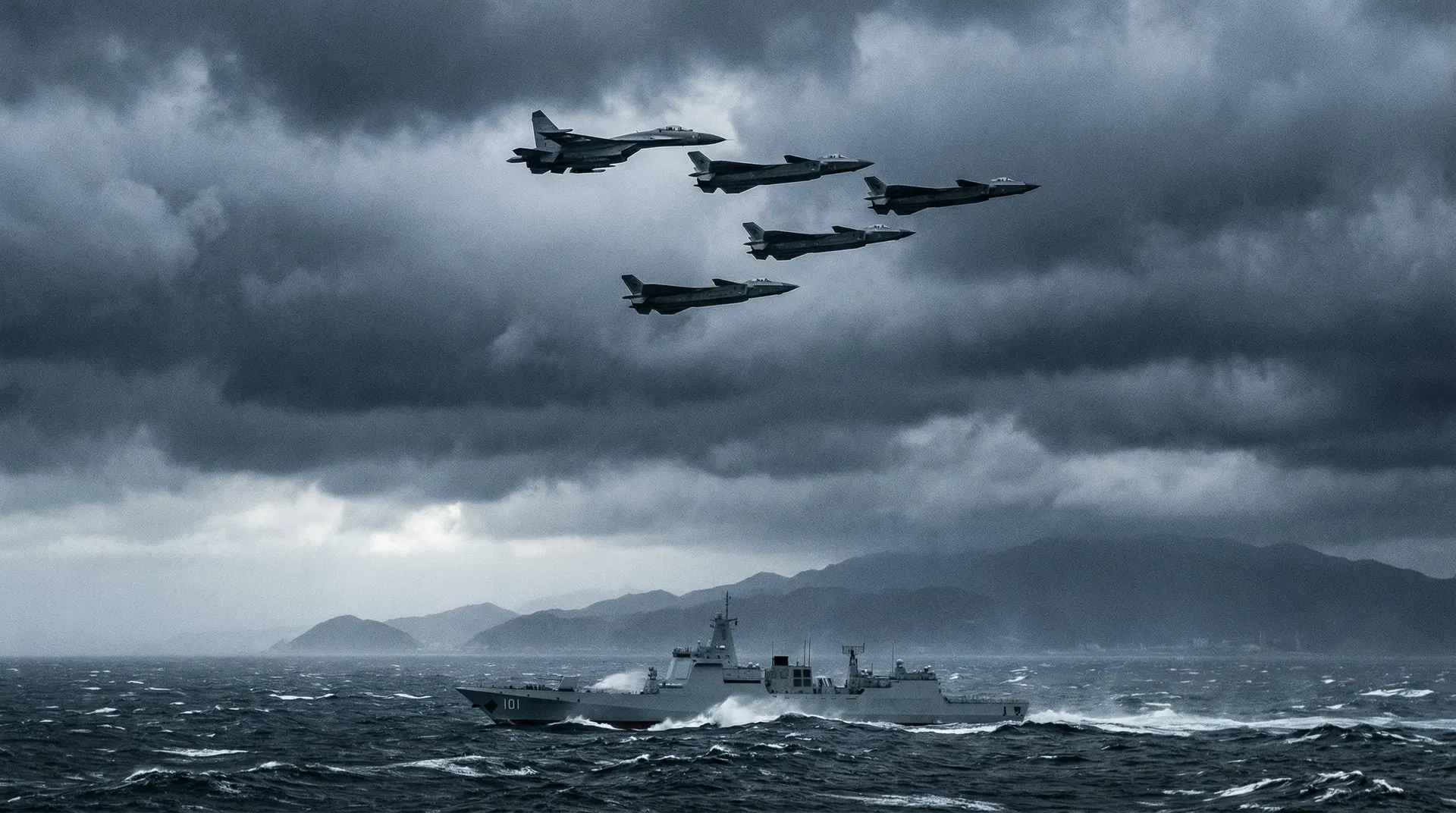
Taiwan’s Ministry of National Defense reported that 26 Chinese military aircraft, including fighter jets and bombers, were detected around the island on Saturday, with 16 crossing the sensitive median line of the Taiwan Strait or entering Taiwan’s air defense identification zone (ADIZ). The flights, which continued on Sunday with joint landing and beach assault drills, represent a significant escalation and have drawn swift condemnation from Taipei and expressions of concern from Washington.
"The peace and stability of the Taiwan Strait are crucial for the entire region," a spokesperson for Taiwan's Mainland Affairs Council said in a statement. "We urge Beijing to cease these provocative actions and return to a path of peaceful dialogue."
A Pattern of Escalation
The latest military maneuvers are part of a broader pattern of escalating pressure by the People's Republic of China (PRC) on Taiwan, which it views as a renegade province to be unified with the mainland, by force if necessary. Throughout 2025, the People's Liberation Army (PLA) conducted a series of increasingly complex and large-scale military exercises, effectively simulating a blockade and invasion of the island. These drills, such as "Strait Thunder-2025A" and "Justice Mission 2025," have been seen by military analysts as not just political signaling but also as valuable training for a potential future conflict.
The Institute for the Study of War noted in a recent report that the PLA's activities have been creeping closer to Taiwan with each exercise, “creating a tighter blockade and the potential for a more rapid escalation of a crisis.” [2] This sentiment is echoed by many international observers who fear that the constant military pressure could lead to a miscalculation or accident, potentially spiraling into a full-blown conflict.
Strategic Implications: A Multi-Pronged Strategy
China's strategy appears to be multi-pronged. On one level, the military exercises are a clear attempt to intimidate Taiwan's government and people, eroding their will to resist unification. The constant threat of invasion is designed to create a sense of inevitability and wear down morale. On another level, these drills provide the PLA with invaluable, realistic training, allowing them to test and refine their joint operational capabilities, particularly in the complex arts of amphibious assaults and naval blockades. This significantly enhances their readiness for a potential invasion scenario.
Furthermore, the exercises serve as a way for Beijing to test the resolve of the international community, particularly the United States. By gradually increasing the intensity and frequency of the drills, China can gauge the level of international tolerance and the commitment of the U.S. and its allies to Taiwan's defense. The ultimate goal, it seems, is to create a geopolitical environment where a military takeover of Taiwan becomes a low-risk, high-reward option for Beijing.
The U.S. Response and the 'One-China' Policy
The United States, which maintains a delicate diplomatic balance through its 'One-China' policy, has repeatedly expressed its concern over China's actions. The U.S. acknowledges Beijing's claim that there is only one China but has never officially recognized the PRC's sovereignty over Taiwan. This strategic ambiguity has been a cornerstone of U.S. policy for decades, allowing it to support Taiwan's self-defense capabilities without formally recognizing it as an independent nation.
In line with this policy, the U.S. recently approved an $11 billion arms package for Taiwan, a move that was vehemently condemned by Beijing. The arms sales, which include advanced missile systems and fighter jet upgrades, are intended to bolster Taiwan's defenses and deter a potential Chinese attack. However, they also add another layer of complexity to the already fraught relationship between the U.S. and China.
"China's President Xi Jinping has said he wants to reunite with Taiwan peacefully, but Beijing has increased the pace of its exercises, leading to concerns about a potential miscalculation or accident that could spiral into a conflict." - PBS NewsHour [1]
What This Means: A Precarious Future
The resumption of Chinese military flights around Taiwan is a stark reminder of the precarious security situation in the Indo-Pacific. The potential for a conflict, whether by design or miscalculation, is very real and the consequences would be catastrophic. A war over Taiwan would not only result in a devastating humanitarian crisis, with countless civilian casualties and mass displacement, but it would also have a crippling effect on the global economy. Taiwan is a lynchpin in the global technology supply chain, and any disruption to its manufacturing capabilities would have far-reaching consequences.
The international community is watching with bated breath, hoping for a de-escalation of tensions and a return to peaceful dialogue. However, with China's increasingly assertive posture and the U.S.'s commitment to Taiwan's defense, the path forward is fraught with peril. The coming months will be critical in determining whether the region is headed towards a new era of stability or a devastating conflict.
Forward-Looking Analysis
Looking ahead, several key factors will shape the future of cross-strait relations. The first is the political leadership in both Beijing and Taipei. President Xi Jinping's long-term ambitions and his willingness to use force to achieve them will be a deciding factor. Similarly, Taiwan's leadership and its ability to navigate the treacherous waters of cross-strait politics will be crucial. The second factor is the role of the United States. The level of U.S. military and diplomatic support for Taiwan will be a key deterrent to Chinese aggression. Finally, the response of the broader international community will also play a significant role. A united front from democratic nations could help to deter Beijing and maintain peace and stability in the region.
The situation remains highly volatile, and the risk of conflict cannot be understated. The world holds its breath, hoping that diplomacy and restraint will prevail over aggression and ambition.
Three experts on U.S. role and response options in Taiwan-China conflict
Special Report: Surprise PRC Military Exercise Around...
The U.S. “One-China” Policy and Taiwan
Frequently Asked Questions
Why is China conducting military exercises around Taiwan?
What is the U.S. 'One-China' policy?
What are the potential consequences of a conflict over Taiwan?
Related Reports

Iran War's Economic Shockwave: Asia Faces Energy Crisis as Oil Tops $106

Myanmar's Sham Parliament Convenes: Military Tightens Grip Five Years After Coup