
Sudan's Civil War Enters Second Year as Humanitarian Crisis Deepens

The Sudan Civil War has entered its second year, resulting in a de facto partition of the country and a devastating humanitarian crisis. The conflict between the SAF and RSF has drawn in regional powers, and international peace efforts have been ineffective.
Sudan on the Precipice: A Nation Fractured by War and Forsaken by the World
KHARTOUM, Sudan – As the calendar turns to March 2026, the second year of Sudan’s devastating civil war begins not with a glimmer of hope, but with the deepening shadow of a nation’s collapse. The relentless power struggle between the Sudanese Armed Forces (SAF) and the paramilitary Rapid Support Forces (RSF) has transcended a mere internal conflict, morphing into a complex, multi-layered crisis that has carved the country in two, ignited a humanitarian inferno, and drawn a web of international actors into its vortex. For millions of Sudanese civilians, the war has become a daily nightmare of violence, displacement, and starvation, with no respite in sight.
The conflict has shattered any semblance of centralized authority, leaving a fractured landscape where a mosaic of over 60 non-state armed groups and warlords vie for control. This fragmentation has rendered traditional peacemaking efforts almost futile, as command and control on both sides have become increasingly diffuse. The international community, paralyzed by its own internal divisions and the conflicting agendas of regional powers, has been largely ineffective in stemming the tide of violence. The result is a nation on the brink, its future held hostage by a war that has become as much a geopolitical chess match as a domestic struggle for power.
The Anatomy of a Divided Nation
The de facto partition of Sudan is a stark manifestation of the country’s deep-seated political and ethnic fault lines. The SAF, led by the unyielding General Abdel Fattah al-Burhan, has consolidated its control over the capital, Khartoum, the strategically vital Nile River valley, and the eastern provinces. This heartland of the Sudanese state, with its historical concentration of political and economic power, has become the SAF’s fortress. In stark contrast, the RSF has established its dominion over the vast, arid expanses of Darfur, a region long marginalized and scarred by decades of conflict. This geographical schism is a mirror image of the ideological chasm that separates the two warring factions.
General al-Burhan’s rhetoric has grown increasingly uncompromising, ruling out any prospect of a negotiated settlement with the RSF. His declaration of the conflict as a “Battle of Dignity” has transformed the war into an existential struggle for the very identity of the Sudanese state. In a fiery speech that reverberated across the nation, he unequivocally rejected any form of power-sharing with the paramilitary group. “There is no coexistence with these rebels,” he thundered. “We will not accept them or welcome their presence among us. We will not join hands with any party that carries arms or supports the rebellion.” This hardline stance has all but extinguished the faint embers of hope for a peaceful resolution, signaling a protracted and bloody war of attrition.
"The military will not accept the presence of the paramilitary group or its political supporters."
- General Abdel Fattah al-Burhan, Head of the Sudanese Armed Forces
A War Without Restraint: The Civilian Toll
The conduct of the war has been marked by a chilling disregard for the laws of armed conflict and a brutal targeting of civilians. Both the SAF and the RSF stand accused of a litany of war crimes, including the indiscriminate shelling of residential areas, extrajudicial killings, and the systematic use of sexual violence as a weapon of terror. The RSF, in particular, has been widely condemned for its use of drone warfare, with unmanned aerial vehicles raining down death and destruction on bustling markets, crowded hospitals, and even convoys of desperate families fleeing the violence.
The early months of 2026 have witnessed a horrifying escalation in the violence. In January alone, a series of RSF drone strikes left a trail of death and devastation across the country. A marketplace in Kartala, South Kordofan, was transformed into a scene of carnage, with five civilians killed. Days later, an attack on an army base in Singa claimed the lives of at least 27 people and left 73 wounded. The SAF, in turn, has been accused of unleashing its own brand of terror from the skies, with devastating airstrikes on civilian areas. One such attack, on the hometown of RSF leader Mohamed Hamdan Dagalo, Al Zorg, reportedly killed up to 64 people, a grim testament to the escalating cycle of revenge and retribution.
The Unfolding Humanitarian Catastrophe
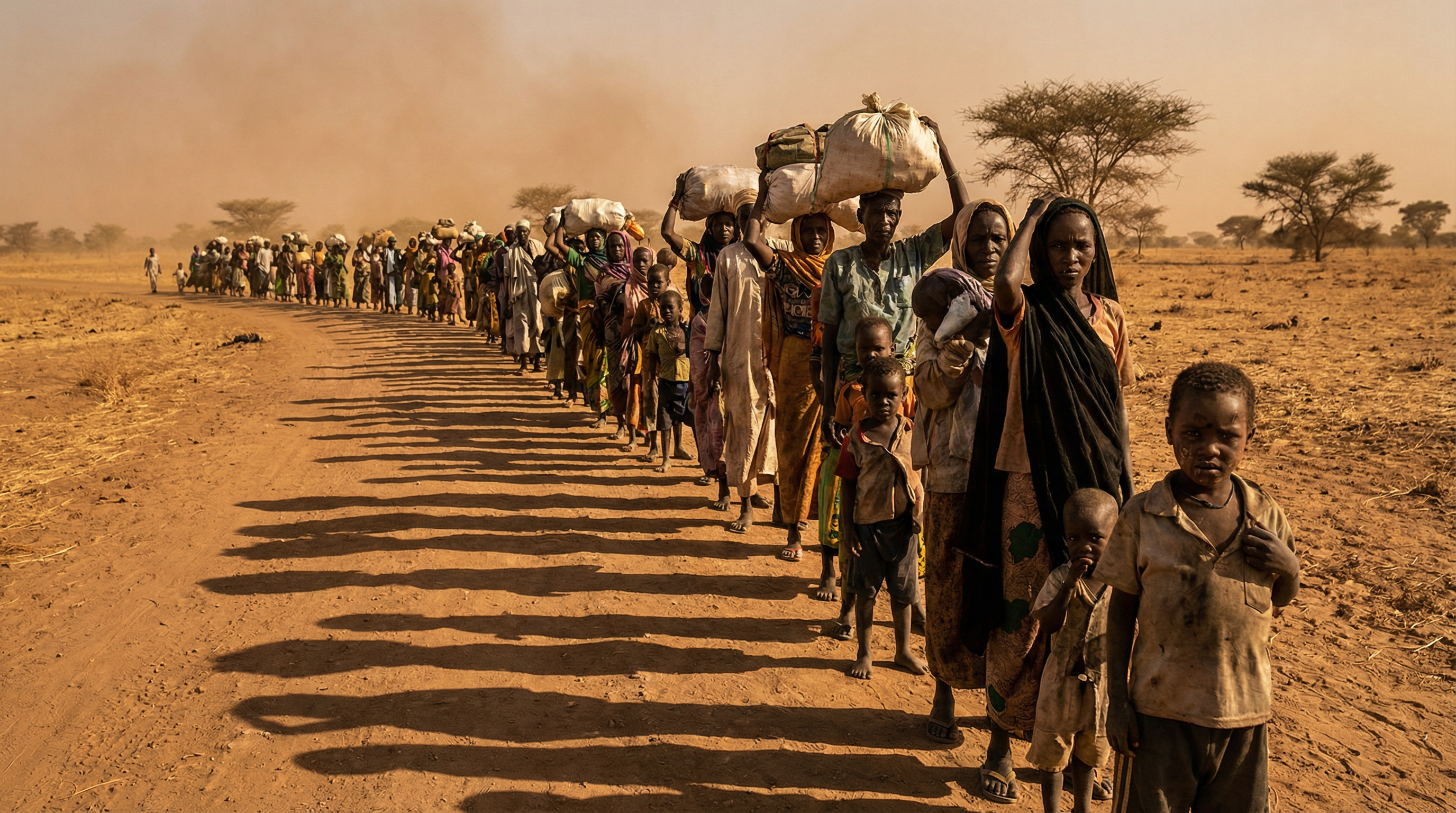
The human cost of the Sudan Civil War is a stain on the conscience of the world. The sheer scale of the displacement is difficult to comprehend, with an estimated 7 million people uprooted from their homes and forced to seek refuge within Sudan’s borders, and another 4.5 million driven into neighboring countries, creating a refugee crisis that threatens to overwhelm the region. The World Food Programme has issued a dire warning of a looming famine in Darfur, a region already haunted by the specter of mass starvation. Across central Sudan, particularly in the Greater Kordofan region, food insecurity is reaching critical levels, pushing millions to the brink of survival.
The delivery of life-saving humanitarian aid has been severely hampered by the ongoing violence and the deliberate targeting of aid workers. The 2026 Humanitarian Needs and Response Plan, a desperate appeal for $2.9 billion to assist 20 million people, remains catastrophically underfunded, with just over 15% of its target met. This funding shortfall has left aid agencies with an impossible choice: who to save and who to leave behind. The result is a humanitarian response that is stretched to its breaking point, unable to cope with the ever-growing needs of a population in freefall.
Strategic Implications: A Tinderbox on the Horn of Africa
The war in Sudan is no longer a localized conflict; it has become a regional tinderbox with the potential to ignite a wider conflagration across the Horn of Africa. The involvement of external powers has transformed Sudan into a proxy battleground for competing geopolitical interests, with Egypt and Saudi Arabia reportedly throwing their weight behind the SAF, and the United Arab Emirates backing the RSF. This has created a paradoxical situation where members of the “Quad” – a diplomatic grouping of the US, Egypt, Saudi Arabia, and the UAE that is ostensibly tasked with mediating the conflict – are simultaneously fanning the flames of war.
The conflict’s spillover effects are already being felt across the region. Neighboring Chad has been drawn into the maelstrom, becoming a critical supply line for the RSF. In a dangerous escalation, the RSF launched a cross-border attack into Chad in January, killing seven Chadian soldiers and prompting the closure of the border. The war has also breathed new life into the long-dormant civil war in South Sudan and has ratcheted up tensions between Eritrea and Ethiopia, two regional heavyweights with a history of animosity.
What This Means: A Path to Ruin
The Sudan Civil War is a complex and multifaceted crisis that is pushing the country down a path to ruin. The intransigence of the warring parties, the fragmentation of the conflict, and the meddling of external actors have created a perfect storm for a protracted and devastating war. The international community’s failure to forge a united front and take decisive action has only emboldened the belligerents and deepened the suffering of the Sudanese people.
As Benjamin Petrini, a Research Fellow at the International Institute for Strategic Studies, astutely observes, “while the conflict is intractable, there are some diplomatic openings spurred by renewed humanitarian pledges.” However, he also highlights the glaring contradiction of “Quad members pursuing peace while also funding the war.” This fundamental hypocrisy lies at the heart of the international community’s failed response to the crisis.
A Faint Flicker of Hope in the Darkness
In the midst of the overwhelming despair, a few faint flickers of hope have emerged. An international donor conference in February 2026 managed to raise pledges of $1.5 billion for humanitarian aid in Sudan. While this is a far cry from the billions that are needed, it is a welcome, if belated, step in the right direction. The recent delivery of aid to the besieged cities of Dalang and Kadugli for the first time since 2024 also offers a small but significant measure of relief to a population that has been cut off from the outside world for far too long.
Ultimately, however, these are but temporary balms on a festering wound. A lasting peace in Sudan will only be possible when the guns fall silent, the warring parties are brought to the negotiating table, and the flow of arms into the country is stanched. The international community, and particularly the regional powers who hold the most sway, must choose a side: the side of peace and the Sudanese people, or the side of war and their own narrow geopolitical interests. The future of Sudan, and the stability of the entire region, hangs in the balance.
Frequently Asked Questions
What is the current situation in the Sudan Civil War?
Who are the main parties involved in the Sudan Civil War?
What is the humanitarian impact of the Sudan Civil War?
Related Reports
Sudan War Enters Third Year: Millions Surviving on One Meal a Day Amidst Famine Fears
Africa Emerges as New Front in Iran's Geopolitical Strategy
