Venezuela's Repressive Apparatus Endures Post-Maduro: A Warning for Intervention
The removal of Nicolás Maduro by U.S. forces has not dismantled Venezuela's deeply entrenched state machinery of repression, with new politically motivated detentions signaling a persistent threat to civil liberties.
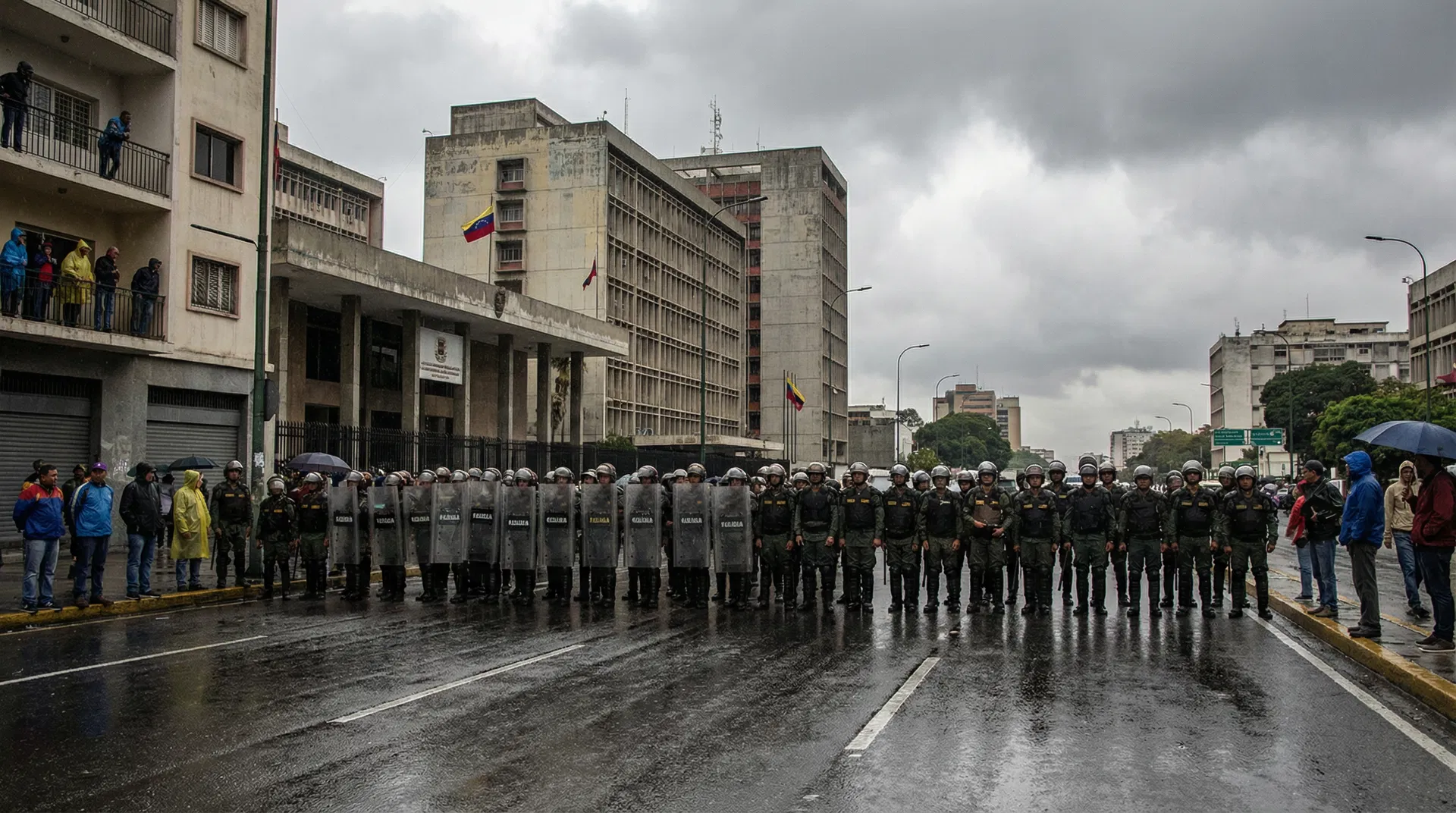
CARACAS, VENEZUELA – The removal of Nicolás Maduro from power by U.S. military intervention has not resulted in the dismantling of Venezuela's deeply entrenched state machinery of repression. Instead, UN investigators and human rights organizations report that the repressive apparatus continues to function with alarming efficiency, with at least 87 new politically motivated detentions documented in the weeks following Maduro's departure. This persistence of authoritarian structures offers a sobering lesson for policymakers contemplating interventions in other complex authoritarian contexts.
The UN Human Rights Council, in a preliminary report released on March 11, documented systematic violations of civil liberties in post-Maduro Venezuela. Despite the removal of the dictator himself, the security forces, intelligence agencies, and judicial system that enabled his rule remain largely intact and operational. Political opponents, journalists, and civil society activists continue to face arrest, torture, and extrajudicial detention.
The removal of Maduro has not resulted in the liberation of Venezuela's people. Instead, it has revealed the depth to which authoritarian structures have penetrated Venezuelan society. The 'deep state' of repression remains fully operational, capable of functioning regardless of who occupies the presidential palace.
The continued detention of political opponents and activists suggests that the transition from Maduro's rule has not fundamentally altered the incentive structures that drive repression in Venezuela. The security forces, many of whom benefited materially from Maduro's regime through corruption and extortion, have little incentive to abandon the practices that enriched them. The judicial system, staffed by judges appointed by Maduro and loyal to the regime, continues to issue convictions based on dubious charges and without due process.
The case of María González, a prominent opposition activist detained on March 8, exemplifies the ongoing repression. González was arrested on charges of 'conspiracy against the state,' a vague accusation commonly used to silence political opponents. No credible evidence has been presented, and her lawyer reports that she has been denied access to legal counsel and subjected to interrogation without witnesses. Such cases are not anomalies; they represent a pattern of systematic abuse.
Human rights organizations operating in Venezuela report that the security forces continue to employ torture, forced disappearances, and extrajudicial detention as tools of political control. The National Guard, the Sebin (intelligence service), and the PNB (national police) remain under the control of officers loyal to the military hierarchy that sustained Maduro's rule. Without a comprehensive purge of these institutions and a fundamental restructuring of the security apparatus, the repression will likely continue.
The persistence of repression in post-Maduro Venezuela highlights a fundamental challenge in transitioning from authoritarian rule: the difficulty of dismantling the institutional structures that enabled dictatorship. Authoritarian regimes do not exist in isolation; they are embedded in networks of institutions, interests, and practices that sustain them. Simply removing the dictator does not automatically dissolve these networks.
The international community has recognized this challenge and has called for comprehensive institutional reform in Venezuela. The United States and European Union have made support for Venezuela's transition conditional on the establishment of independent judicial institutions, the purging of security forces implicated in human rights abuses, and the creation of mechanisms for accountability and reconciliation.
The Venezuelan case offers critical lessons for policymakers contemplating military interventions in other authoritarian contexts. The removal of a dictator is not equivalent to the establishment of democracy. True democratic transition requires the painstaking, often thankless work of rebuilding state institutions on foundations of justice, accountability, and the rule of law.
Related Reports

Iran War's Economic Shockwave: Asia Faces Energy Crisis as Oil Tops $106

Myanmar's Sham Parliament Convenes: Military Tightens Grip Five Years After Coup