Israel–Iran Conflict Explained: From the Islamic Revolution to the 2026 War

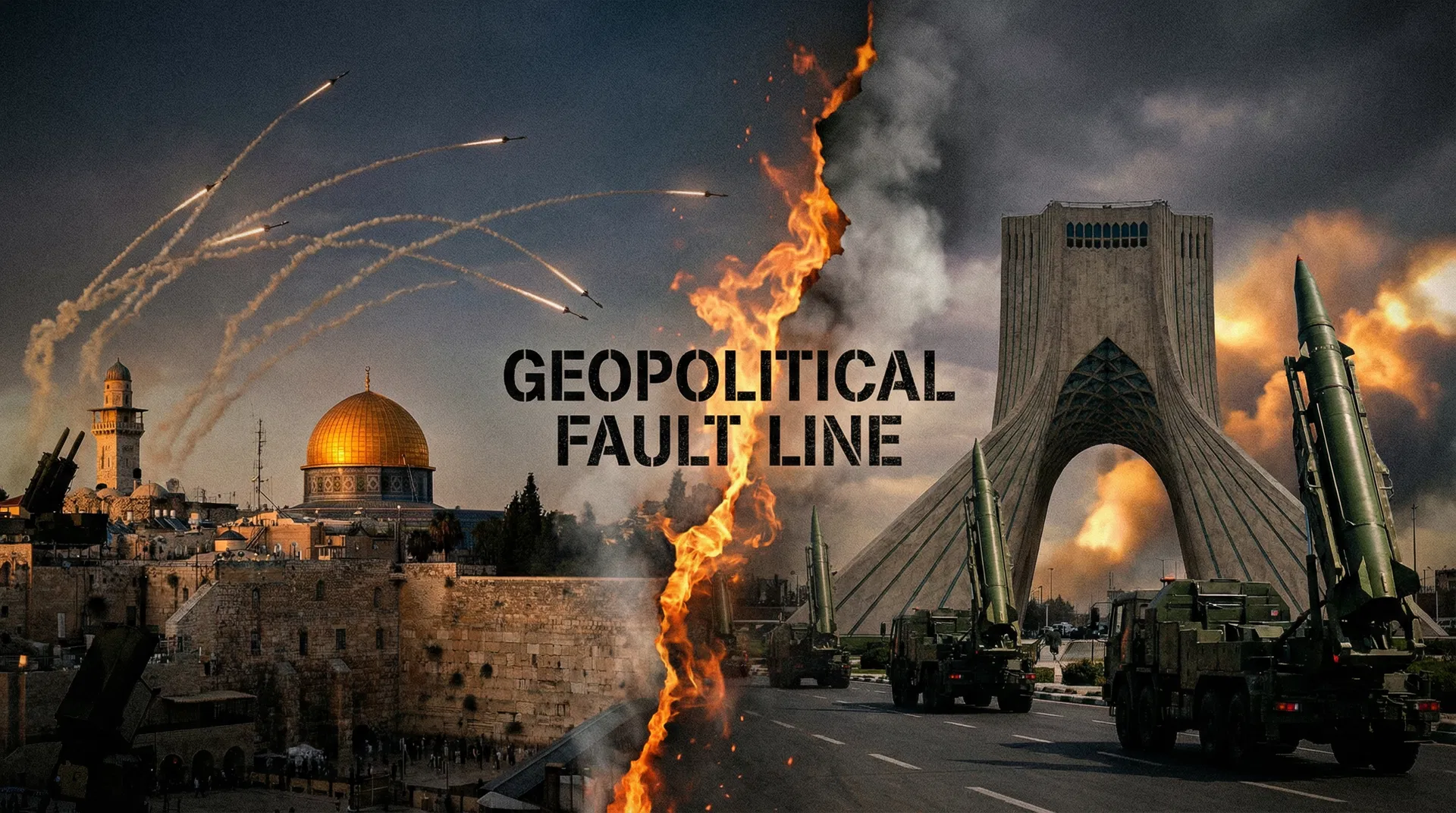
The Israel-Iran conflict has evolved from a pragmatic partnership before 1979 to a bitter rivalry following the Islamic Revolution. The conflict has been characterized by proxy wars (Hezbollah, Hamas, Houthis), a clandestine shadow war including assassinations and cyberattacks (Stuxnet), the nuclear crisis and JCPOA negotiations, and most recently, direct military confrontations in 2024–2025. The February 2026 US-Israel war on Iran represents the most dangerous escalation yet.
The conflict between Israel and Iran is one of the most consequential rivalries in the modern Middle East. What began as a period of pragmatic cooperation has devolved into a bitter struggle characterized by proxy wars, a nuclear arms race, clandestine assassinations, and, most recently, direct military confrontations. This conflict has shaped the geopolitical landscape of the Middle East for nearly five decades and continues to pose a threat to regional and global stability. Understanding the origins, evolution, and current state of this conflict is essential for comprehending the Middle East and the broader geopolitical landscape.
From Partnership to Enmity: The Pre-1979 Era
Before the 1979 Islamic Revolution, Iran and Israel maintained a complex but generally positive relationship. Iran under the Shah, Mohammad Reza Pahlavi, was a close ally of the United States and a secular monarchy that shared strategic interests with Israel. While Iran voted against the UN Partition Plan for Palestine in 1947, it became the second Muslim-majority nation to recognize Israel in 1950. The two countries engaged in covert intelligence sharing, military cooperation, and economic ties. This pragmatic partnership was based on shared interests in countering Soviet influence and containing Arab nationalism.
The Islamic Revolution and the Ideological Shift (1979)
The overthrow of the Shah and the rise of Ayatollah Ruhollah Khomeini marked a radical turning point in the relationship. The new Islamic Republic of Iran severed all ties with Israel, viewing it as an illegitimate "Zionist entity" and an outpost of American imperialism in the Middle East. This ideological hostility became a cornerstone of Iranian foreign policy and remains so to this day. The Iranian Revolution also introduced a new element to Middle Eastern politics: a revolutionary Islamic ideology that challenged the existing order and sought to export its revolution throughout the region.
The Proxy War Era (1980s–2000s)
During the Iran-Iraq War (1980–1988), Iran began to cultivate a network of regional proxies to project its power and challenge its adversaries. This "Axis of Resistance" included groups like Hezbollah in Lebanon, which would become a major player in the conflict with Israel. Hezbollah, founded in 1985 with Iranian support, became a powerful Shia Islamist political and militant organization that posed a significant threat to Israel's northern border.
In the 1990s and 2000s, Iran expanded its network of proxies to include Palestinian groups such as Hamas and Palestinian Islamic Jihad. These groups received extensive support from Iran, including funding, weapons, and training. Iran also cultivated relationships with other regional actors, including the Houthis in Yemen, a Zaidi Shia movement that would later become a significant player in the conflict.
The Shadow War: Assassinations and Cyberattacks (2000s–2010s)
Parallel to the proxy war, Israel and Iran engaged in a clandestine "shadow war" characterized by targeted assassinations, sabotage, and cyberattacks. The most prominent victims of this shadow war were Iranian nuclear scientists. Between 2010 and 2015, at least five Iranian nuclear scientists were assassinated in attacks widely attributed to Israel's Mossad intelligence agency. These assassinations were designed to disrupt Iran's nuclear program and to send a message to Iranian leadership about the costs of pursuing nuclear weapons.
The most dramatic episode of the shadow war was the discovery of the Stuxnet computer worm in 2010. Stuxnet was a highly sophisticated cyberweapon believed to have been jointly developed by the United States and Israel. The worm targeted Iran's nuclear facilities, particularly the Natanz uranium enrichment plant, and caused significant damage to Iran's nuclear centrifuges. The discovery of Stuxnet marked the first known use of a cyberweapon to cause physical damage to critical infrastructure and demonstrated the emergence of cyber warfare as a tool of statecraft.
The Nuclear Crisis and the JCPOA (2015–2018)
The Iranian nuclear program has been at the center of the Israel-Iran conflict for decades. Israel has consistently maintained that it will not allow Iran to acquire nuclear weapons, viewing such an outcome as an existential threat. Iran has maintained that its nuclear program is for peaceful purposes, though international inspectors have found evidence of past military dimensions to the program.
In 2015, after years of negotiations, Iran and the P5+1 (the five permanent members of the UN Security Council plus Germany) reached the Joint Comprehensive Plan of Action (JCPOA), or the Iran nuclear deal. The deal imposed strict limits on Iran's nuclear activities in exchange for the lifting of international sanctions. While the JCPOA was hailed by many as a major diplomatic achievement, it was fiercely opposed by Israel, which argued that it did not go far enough to dismantle Iran's nuclear program.
In 2018, the Trump administration withdrew the United States from the JCPOA and reimposed sanctions on Iran. This move was welcomed by Israel but criticized by other signatories, who sought to keep the deal alive. The US withdrawal from the JCPOA dealt a severe blow to the agreement and marked a turning point in the conflict, as Iran began to gradually breach the terms of the agreement in response to the reimposition of sanctions.
The Shift to Direct Conflict (2024–2026)
The year 2024 marked a dangerous new phase in the conflict, with Iran and Israel engaging in direct military strikes for the first time. In April 2024, in response to a suspected Israeli airstrike on its consulate in Damascus, Syria, which killed several high-ranking IRGC commanders, Iran launched an unprecedented barrage of over 300 drones and missiles at Israel. The attack was largely thwarted by a coordinated defense effort involving Israel, the United States, the United Kingdom, France, and Jordan.
Israel retaliated with "Operation Days of Repentance," a series of airstrikes targeting military sites across Iran. Israeli officials claimed the operation successfully crippled Iran's missile production capabilities and severely degraded its air defense network. The tit-for-tat exchanges of 2024 escalated into a brief but intense conflict in June 2025, known as the Twelve-Day War, triggered by Israeli airstrikes on Iranian nuclear facilities and military installations.
The current and most perilous chapter in this long-running conflict began on February 28, 2026, with the launch of a joint US-Israeli military campaign against Iran. The stated objective of the campaign is to bring about a change in the Iranian regime. A major turning point in the war occurred on the very first day, with the assassination of Iran's Supreme Leader, Ayatollah Ali Khamenei, in a targeted strike. This act has created a power vacuum in Iran and has dramatically altered the trajectory of the conflict.
Key Players in the Conflict
The Islamic Republic of Iran:
Led by a hardline clerical establishment, Iran is driven by a combination of revolutionary ideology, national pride, and strategic ambition. The Islamic Revolutionary Guard Corps (IRGC) and its elite Quds Force are the primary instruments of Iranian power projection in the region.
The State of Israel:
A parliamentary democracy and a close ally of the United States, Israel views Iran as an existential threat. The Israeli government has consistently maintained that it will not allow Iran to acquire nuclear weapons.
The United States:
Related Reports
US-Iran Ceasefire Talks Collapse: US Navy Blockades Iranian Ports as Fragile Truce Holds
Israel Escalates Lebanon Campaign as Ceasefire Excludes Hezbollah Ahead of Washington Talks