Trump Condemns 'Foolish' NATO Allies, Claims Iran War Prevented Nuclear Holocaust

President Trump claimed the US has 'wiped out' Iran's military and condemned NATO allies as 'foolish' for refusing to help with Strait of Hormuz operations. He warned the war prevented a 'nuclear holocaust' and suggested rethinking the NATO relationship. European allies have rejected his demands, calling the conflict 'not our war,' while military analysts question whether the administration has a viable exit strategy.
WASHINGTON — President Donald Trump delivered his most combative assessment of the Iran war to date in a wide-ranging Oval Office press conference on Tuesday, claiming the United States has effectively destroyed Iran's military while simultaneously excoriating NATO allies for refusing to contribute to operations in the Strait of Hormuz. The remarks signal a deepening transatlantic rift that threatens the foundations of the Western alliance.
Asked whether the administration was seeking allied support to escort oil tankers through the mined strait, Trump was dismissive. "We don't need any help," the president declared. "We've wiped out their navy, their air force, their military in every aspect." The claim, while reflecting the significant damage inflicted on Iran's conventional forces, overstates the current military reality. Iran retains substantial asymmetric capabilities, including its extensive network of proxy forces, underground missile facilities, and the mines that continue to paralyze shipping through the Hormuz chokepoint.
MILITARY CLAIMS VS. REALITY — Pentagon officials have confirmed that US and Israeli strikes have severely degraded Iran's air force and naval surface fleet, destroying an estimated 80% of Iran's fighter aircraft and sinking or disabling most of its major warships. However, Iran's Islamic Revolutionary Guard Corps Navy — which operates independently from the regular navy and specializes in asymmetric warfare using fast attack boats, anti-ship missiles, and naval mines — remains a potent threat.
The Strait of Hormuz itself remains effectively closed to commercial shipping, with the US Navy's minesweeping operations proceeding far more slowly than initially projected. Maritime security analysts estimate that fully clearing the strait could take three to six months, even under optimal conditions — a timeline that contradicts the administration's narrative of swift military dominance.
Trump also claimed that a senior Iranian official "responsible for killing thousands of protesters" had been recently killed, though the administration did not provide specific details or confirmation of this claim. If verified, such a strike would represent a significant escalation in the targeting of Iran's political and security leadership.
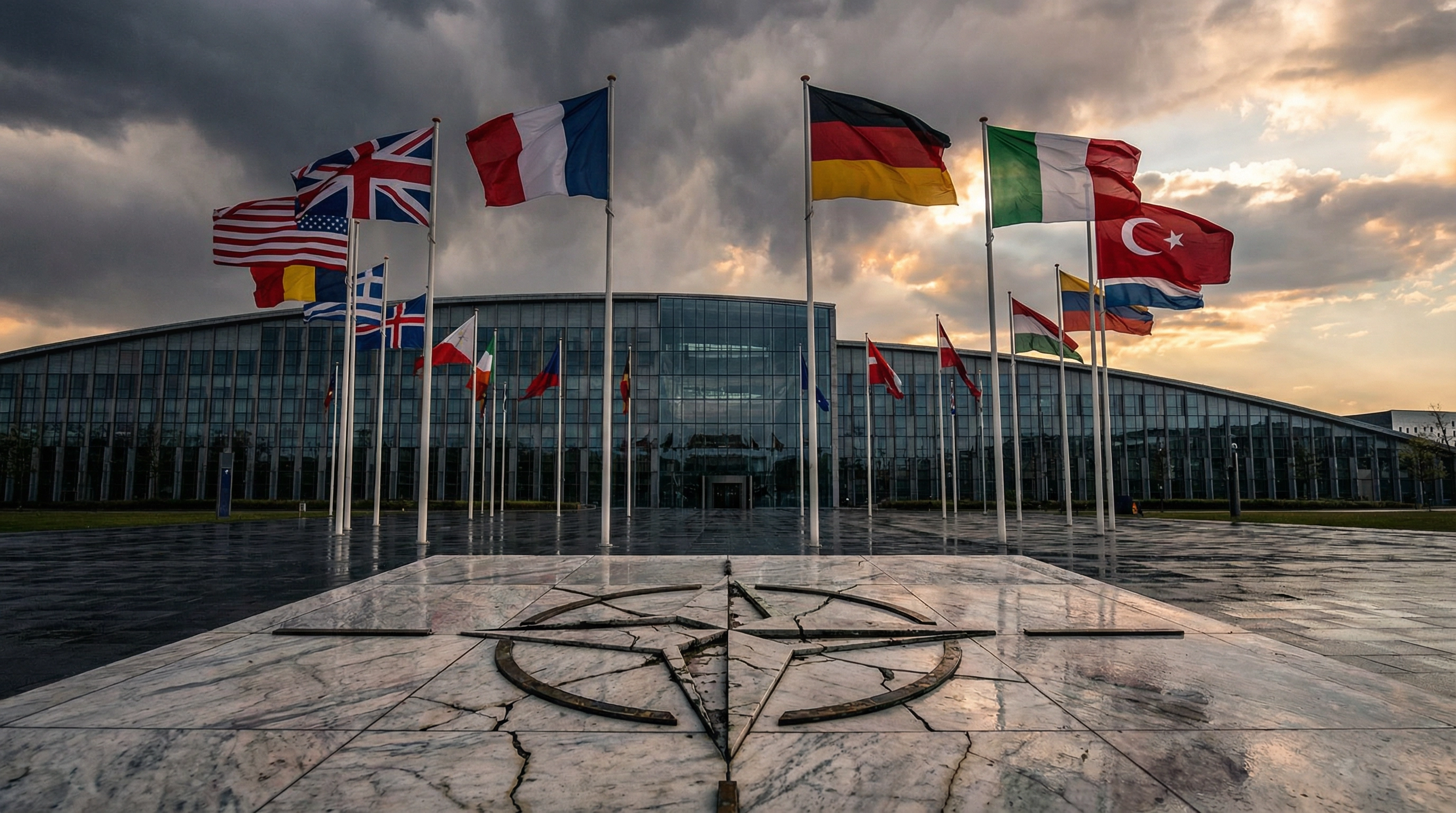
NATO FRACTURE — The president's sharpest words were reserved for America's traditional allies. "They all agreed with what we did — they said Iran was a threat," Trump said of NATO members. "But they don't want to help us. I find that amazing." The criticism comes after European leaders, led by Germany and the United Kingdom, publicly rejected Trump's demand to join a US-led naval coalition in the Hormuz strait.
Trump drew a pointed contrast between allied reluctance on Iran and the hundreds of billions of dollars the United States has spent supporting Ukraine's defense against Russia. "We've spent hundreds of billions on Ukraine, and now they won't even help us with this," the president said, framing the allied refusal as evidence of a fundamentally unequal partnership.
European officials have pushed back forcefully against this characterization. NATO Secretary General Mark Rutte has emphasized that the alliance's mutual defense obligations under Article 5 do not extend to what European capitals view as a unilateral American military campaign. Several European diplomats have privately noted that the US did not consult allies before launching strikes on Iran, making it unreasonable to expect their participation after the fact.
RETHINKING NATO — In perhaps the most consequential statement of the press conference, Trump suggested he is actively reconsidering the United States' relationship with NATO — a decision he claimed he could make unilaterally without congressional approval. While Trump has previously threatened to withdraw from the alliance, the current context of an active military conflict and a genuine transatlantic split gives the threat new weight.
Legal scholars are divided on whether the president could unilaterally withdraw from NATO. Congress passed the NATO Support Act in 2023, which requires Senate approval for any withdrawal, but the executive branch has historically claimed broad authority over foreign policy and treaty obligations.
THE VIETNAM QUESTION — When a reporter asked whether the Iran conflict risked becoming "another Vietnam" — a prolonged quagmire with no clear exit strategy — Trump was characteristically defiant. "I'm not afraid of anything," the president responded, dismissing the comparison without addressing the underlying strategic concern.
The Vietnam analogy has gained traction among military analysts and former officials who worry that while the US can inflict devastating damage on Iran's conventional forces, it lacks a viable plan for achieving lasting political objectives. Iran's vast territory, mountainous terrain, and population of 88 million make any ground occupation virtually impossible, while the country's proxy network across the Middle East provides multiple avenues for asymmetric retaliation.
As the war enters its third week, the gap between the administration's triumphalist rhetoric and the complex reality on the ground continues to widen. The Strait of Hormuz remains closed, oil prices remain above $100 a barrel, and America's closest allies are openly distancing themselves from the conflict — a combination of factors that suggests the war's consequences may prove far more enduring than the president's confident pronouncements imply.
Frequently Asked Questions
Has the US really 'wiped out' Iran's military?
Why are NATO allies refusing to help in the Strait of Hormuz?
Can Trump withdraw the US from NATO without Congress?
Is the Iran war becoming another Vietnam?
Related Reports

Europe and NATO Reject Trump's Hormuz Coalition: 'This Is Not Our War'
 Fatima Al-Rashid8 min read
NATO Deploys Maritime Strike Group to Strait of Hormuz Amid Iran Standoff
 Sarah Blackwood9 min read
US-Israel War on Iran Escalates: Intense Airstrikes, Civilian Toll, and Strait of Hormuz Mined
 James Harrington8 min read
Russia Emerges as Big Winner of Iran War: Sanctions Lifted, Oil Revenue Soars
James Harrington8 min read